Jan Keith Lipes, M.D. –– Reflective Impressionism

Jan Lipes

Jan Lipes looked to his past to reshape his future.
by Bruce B. Blackburn III

“As much as water or food, people need art to survive,” declares New Hope, PA artist Jan Lipes of the importance of art in our lives. “That’s held true in my own case. It really is my reason for being here. Without it, I don’t see any other way to interact with the globe. It’s what I do—what I need to do.”
Passion such as this helps define the artist, who describes his paintings as “epiphanies,” which he says are inspired by life’s everyday scenes. Soft-spoken and gracious, Jan projects the air of a thoughtful individual who is serious about his work and determinedly pursuing his role as artist. Art, in fact, has been his salvation. You see, Jan never planned to paint, and how he became an artist is a one-of-a-kind, inspiring tale.                      Doing the Right Thing
Born and raised in Bronx, NY, the sixty-two year-old artist spent his student years preparing for medical school. After high school he earned a degree in Literature from City College and an M.D. from the Albert Einstein College of Medicine, both in New York. In 1981, he and his wife, Janet, moved to Solebury, PA where a position as emergency department physician awaited him at nearby Doylestown Hospital. He fell irrevocably in love with the Bucks County countryside, and he loved practicing medicine. “When I went into medicine there was never any question about it,” he recalls. “I thought: I’m going to be a healer and that’s a good thing to do. I wasn’t tortured about the validity of my life’s work, I had no doubts about what I was doing.”
In his early thirties, Jan was diagnosed with multiple sclerosis, and the disease took its toll as time passed, so that by 1993 he could no longer handle the physical demands of his job. He left the hospital confined to a wheelchair. His sons were young and he was determined to be an involved father. He wondered—How will I manage?  What can I do that gives my life meaning?
What can I do that gives my life meaning?                                                                 The answers came by looking to his past. “I asked myself what stirred me the most other than medicine,” he says.“Before I disappeared into the bowels of the hospital for twenty years and lost touch with my art side, I was constantly doodling,” he explains. The pages of his school notebooks were laced with drawings. Even as a physician, he was always pulled toward art. He sketched in pen and ink, took pottery lessons in Manhattan, had drawing sessions with his children, learned black-and-white photography and did his own darkroom work. “Art was always surfacing.” he says.
Once Jan made up his mind, he began another journey entirely: he would learn how to paint. As surely as he’d known without reservation that medicine had once been the perfect career choice, he knew that being an artist would be equally fulfilling.
Fine Tuning
“It was trial and error,” he says. I picked up a brush and started doing it. I pushed paints around on the palette and eventually started to get somewhere.” Having lost the use of his dominant right hand, he worked to fine-tune his left hand’s coordination. Immediately he loaded up his palette with far too many paints. His motor skills improved, but more elusive was figuring out what colors he would use for his personal palette. “I did a brutal surgery on my palette and brought the number of colors down to five or six. I’m still using those same basic colors.”
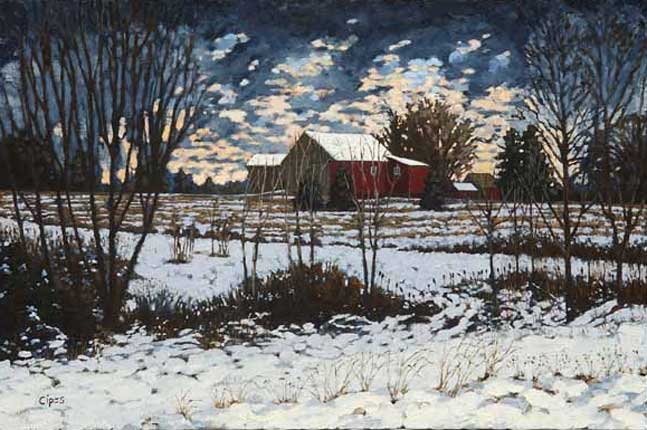
Along with architecture, riverscapes and canal views, landscapes are Jan’s primary subjects, which he paints in the style of the New Hope Impressionists before him. There is an ordered, well-balanced aspect to his compositions. Similar to the writer whose every word is carefully chosen to enhance his story, every brush stoke Jan employs is essential to his canvas. Colors are vibrant, by turns tonalist and Fauvist, and his paintings often contain mirror-like reflections off the canal and river he so likes to portray.
A Contemplative Journey
His airy, light-filled studio looks out on a spacious yard lush with mature landscaping—a view that inspires peaceful rumination.
Jan once painted plein air, and Janet made it possible. “She carried my easel, toolbox, canvases—everything!—and set me up in these out-of-the-way places so I could paint. She was taking care of two adopted kids as well as our own.” There were also other distractions, and his technique required uninterrupted attention; his home studio offered refuge. “Janet served as a great inspiration to me. She was my best critic critic and provided me all around support. Without her help, I would have never have accomplished what I’ve accomplished,” he insists.
“I’m not a quick painter, I’m slow and deliberate, my paintings take a long time to do,” he says. “They evolve. I see things emerge. It’s a whole process, a contemplative journey.” To judge by viewer reaction to his painting, the artist has found sure footing on his new life path.
Jan’s paintings have captivated many fans, accumulated numerous awards, and been exhibited at art shows and galleries throughout the region. His refreshing perspective of the New Hope-Lambertville Bridge, Free Bridge Sister Towns, became the poster and auction painting for the 2002 Lambertville-New Hope Winter Arts Festival, and he is featured/cover artist for the Area Guide to Bucks and Hunterdon Counties 33rd edition, 2002-2003. He is represented in Philadelphia by Newman Gallery and in New Hope by Gratz Gallery & Conservation Studio. He also had a weekly column on art for the Bucks County Herald.
“As I’m working, my focus is entirely on each painting and completing it. After that, like children, they’re on their own, launched into the world. It’s thrilling to think about where they’re going to go!” Like collectors of fine antiques, he subscribes to the concept that we play a caretaker role when it comes to fine objects; that antiques and art enrich our lives for a finite time until passed on to another appreciative custodian.
Recycling the World
Driven to create art, Jan says “I have a tremendous compulsion to paint. It must come out, I can’t just keep it in, it’s got to be recycled.” That’s how he sees what he’s doing: recycling the world around him into another form—his paintings.
“People say I’m inspirational, but I’m nothing special. Everybody has their challenges. My struggles are like other peoples’ struggles,” he observes. “Some have more, others fewer.” Ever expanding his scope, Jan just last year began painting night scenes and incorporating snow into his repertoire. Whatever else life holds, he has discovered, the learning goes on forever.

###

Jan Lipes has never let his illness define him…in fact, he is the definition of the Power of an Unbreakable Spirit. He did not resign to his challenges…he faced them head on, rose above them and, used them as a platform to redefine who his is. To learn more about     Jan Lipes and see more of his artwork, go to: janlipes.com

Sunset Lambertville 630x430

         Sunset Lambertville 630 x 430

Apres le Deluge 647x430

           Apres le Deluge 647 x 430

Go back

Your message has been sent

Warning
Warning
Warning
Warning

Warning.

Malala Yousafzai…Unbreakable!

gty_malala_yousafzai_quote_ll_131004_wmain

GLOBAL SYMBOL OF AN UNBREAKABLE SPIRIT

Malala Yousafzai is a global symbol of an “Unbreakable Spirit,” A year ago this week 15-year-old Malala Yousafzai was brutally attacked on her way home from school — shot in the head at point-blank range by the Taliban.

One year later, the shot heard round the world has given birth to a movement of change — a movement to educate girls, and the little girl from Swat Valley in Pakistan has become an international symbol of courage and hope.

“In some parts of the world, students are going to school every day. It’s their normal life,” Malala told Diane Sawyer in an exclusive interview for ABC News. “But in other parts of the world, we are starving for education … it’s like a precious gift. It’s like a diamond.” A diamond she was willing to risk her life for.

Malala was named for a famous Afghan woman warrior and when the Taliban issued an edict banning all girls from going to school, she spoke up when no one else would. She blogged about the Taliban attacks on schools for the BBC, and even appeared in a New York Times documentary, saying defiantly: “They cannot stop me. I will get my education — if it is in home, school, or anyplace.”

Even though she knew there had been threats made against her, she says she never expected the Taliban to harm a young girl. But she did rehearse in her own mind what she would do if attacked.

EDUCATION IS IMPORTANT

“It was always my desire before the attack that if a man comes … I would tell that man that education is very important,” Malala told Sawyer. “I will tell that man that I even want education for your daughter.”

“And you think that would work against a gun?” Sawyer asked. “I thought that words and books and pens are more powerful than guns,” Malala answered.

And on Oct. 9, 2012 as she and her friends were singing on the way home, playing the sides of her school bus like a drum, she never imagined that the young man who boarded the bus and asked “Who is Malala?” was an assassin sent by the Taliban to kill her.

“On the day when I was shot, all of my friends’ faces were covered, except mine,” Malala said. “It was brave, but was it wise?” Sawyer asked Malala. Malala answered: “At that time, I was not worried about myself. I wanted to live my life as I want. ”

She doesn’t remember the man pointing his Colt .45 and firing three bullets at point blank range. Bleeding heavily, unconscious, Malala was rushed to a local clinic, then to a hospital where a military surgeon saved her life by removing part of her skull as her brain began to swell. She was transported to a military hospital, and then days later airlifted to England. She calls it her “seven days of coma dreams.”

AM I DEAD OR AM I ALIVE

“At the time, I was — thinking that am I dead or am I alive?” Malala said. “If I am dead, I shall be — in a graveyard. But then I said, you are not dead. You can talk to yourself. How can you be dead? Then I said, ‘You are alive.’… just hope. One day you will wake up.”

Today, after numerous surgeries and intensive physiotherapy, Malala is attending school in Birmingham, England, and says she is “totally recovered.” She says she loves music, drama and physics — and remains extremely competitive.

“Do you know how close you came to death?” Sawyer asked. “I think death didn’t want to kill me. And God was with me,” Malala said. “And the people prayed for me… And now, I know that you must not be afraid of death. And you must move forward. You must go forward, because education and peace is very important.”

Malala’s miraculous recovery has taken her on an extraordinary journey from a remote valley in northern Pakistan to the halls of the United Nations in New York. At sixteen, she has become an international symbol of peaceful protest and the youngest nominee ever for the Nobel Peace Prize.

I AM MALALA

Malala’s story just came out in a book this week entitled, “I am Malala.” It will make you believe in the power of one person’s voice to inspire change in the world.

I am MalalaI AM MALALA is the remarkable tale of a family uprooted by global terrorism, of the fight for girls’ education, of a father who, himself a school owner, championed and encouraged his daughter to write and attend school, and of brave parents who have a fierce love for their daughter in a society that prizes sons.

Don’t miss a special primetime hour on Malala, “Unbreakable,” airing on “20/20,”October 11th at 10 p.m. ET.

(Excerpts were taken written by Teri Whitcraft and Muriel Pearson from ABC News via World News.)

Tony Bennett…It’s the Good Life. Was it Always??

fb_img   images

TONY BENNETT NEEDS NO INTRODUCTION

Tony Bennett needs no introduction. He may have left his heart in San Francisco, his signature song, but this legend is global and bridges the generation gap. He has had a non-stop journey of accomplishments and at 87, he recently completed “Duets: An American Classic”  CD with such luminaries as Lady GaGa, Mariah Carey, Andrea Bocelli, Josh Groban to name a few, that has sold more copies than any album in his career. He is the oldest Number One Performer.

We would all aspire to be like Tony Bennett…a consummate artist and performer whose unpretentious style and consistent pursuit of excellence has led to his success.

One would think he has always led a charmed life. Yet, there was a time in his career where he had a change in fortune.

IN 1964

In 1964, with the competition of the Beatles and the influx of Rock and Roll, he was struggling with the change in the public’s taste in music. His singing career took a downturn and he left Columbia Records. He began using cocaine and marijuana, he separated from his first wife and, his debts grew to the point of bankruptcy with the IRS trying to seize his home in LA. I don’t know about you, but I was shocked to hear this but, impressed that the power of an unbreakable spirit led him to overcome his challenges.

A near death experience, passing out in a bath tub, scared Bennett into changing his habits. In this defining moment in his life most people would have landed in an abyss never to be heard from again.

TONY’S STRONG INNER DYNAMICS

Tony’s strong inner dynamics and resilience rejuvenated his career. How you may say? What he was doing wasn’t working and he figured out another way. He brought back his original style, he hired his son Danny as his manager and, he went back to Columbia Records. Tony staged a strong comeback and has been moving the hearts and souls of his audience ever since.

Tony Bennett said recently, “I will never retire, I will keep performing because I love it.”

And we love you Tony Bennett…thank you for your inspiration and teaching us that life will have detours and…it’s not what happens, it’s what we do about it that shapes our destiny.

###

$T2eC16h,!)cE9s4Pvm2PBQ05uKQIrQ~~60_35

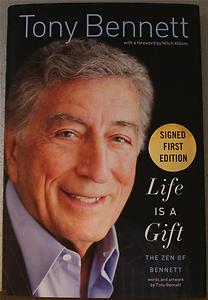
Tony Bennett’s latest book “Life is a Gift” is a moving and inspiring memoir from one of the greatest musical artists of all time.” His given name is Anthony Dominick Benedetto, and Benedetto in Italian means ‘the blessed one.’ I think you will agree, we have been blessed.